
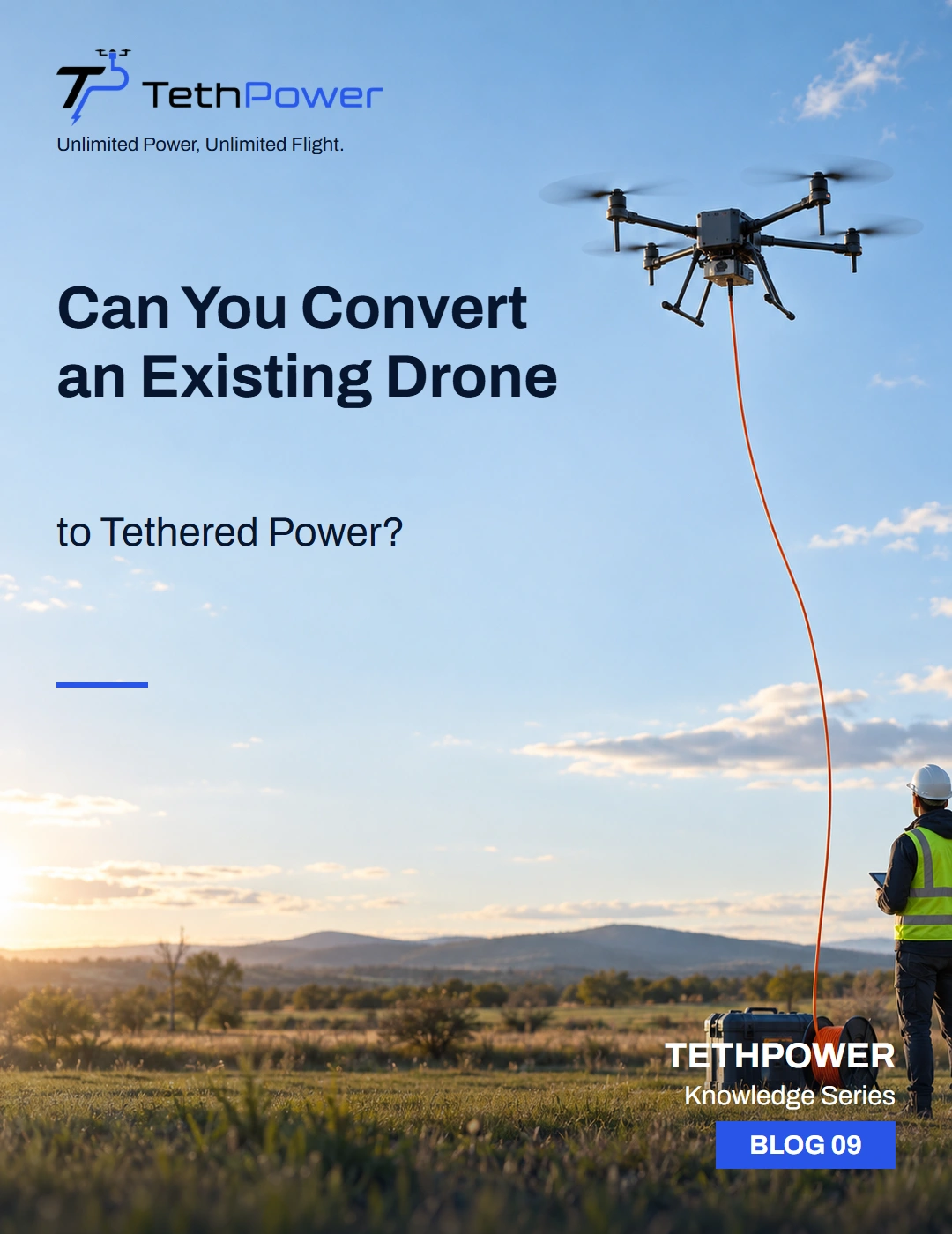
Quick answer: Often yes, but not every UAV is equally easy to convert. The key questions are whether the aircraft electrical bus can accept an external regulated supply, whether the tethered power module can cover continuous and peak demand, and whether the aircraft has enough payload, installation space, cooling and safe battery-backup integration.
Many tethered UAV projects do not begin with a purpose-built tethered aircraft. They begin with an existing multirotor that already has the flight controller, propulsion system, payload and software the operator wants to keep.
Converting that aircraft to tethered operation can be practical, but the engineering review has to go beyond matching a wattage number. The conversion changes how energy reaches the aircraft and adds new electrical, mechanical and operational constraints.
The Basic Conversion Architecture
A typical conversion can be simplified as:
AC source → Ground power station → High-voltage tether → Airborne DC/DC module → UAV power bus / battery path
The ground station raises the transmission voltage so useful power can travel through a relatively lightweight tether. The airborne DC/DC module then converts that high-voltage input into the voltage required by the aircraft.
1. Confirm the Aircraft Voltage Architecture
Start with the battery or DC bus voltage, not the motor specification. The tethered airborne module must reproduce a voltage range the aircraft can safely use. Two UAVs with similar power demand may use very different electrical buses, so power rating alone does not establish compatibility.
- Battery nominal voltage and full-charge voltage
- Number of battery packs and whether they operate in series or parallel
- Allowed external power input range, if documented
- Connector and polarity requirements
- Any BMS, smart-battery or communication dependency
2. Measure Real Continuous and Peak Power
Use actual hover and mission data whenever possible. Motor maximum ratings are not a substitute for measured aircraft demand. The tethered system must support sustained flight and the payload while preserving enough transient capability for takeoff, gust response and maneuvering.
- Stable hover power with the intended aircraft configuration
- Power with the mission payload active
- Known transient peaks and how long they last
- Expected temperature, altitude or cooling conditions
3. Decide How the Original Battery Will Be Used
Many conversions retain the original battery as a backup energy source instead of removing it completely. In that architecture, the battery can support short power peaks or provide limited energy during an interruption in tethered power.
The exact power-sharing behavior depends on the aircraft, battery, BMS and airborne module. The backup battery should therefore be treated as part of the power-path design rather than assumed to be electrically passive.
4. Check Payload Margin
Tethered conversion adds airborne mass: the DC/DC module, brackets, connectors and the suspended portion of the tether. The aircraft must retain enough payload margin after the mission payload is installed.
- Aircraft maximum takeoff weight and recommended operating limits
- Actual payload already installed
- Airborne module and mounting mass
- Suspended tether load at the intended height
- Additional hose or mission-line load for cleaning or other applications
5. Evaluate Mounting, Cooling and Cable Routing
A compact module is still unsuitable if it blocks sensors, changes the center of gravity excessively, interferes with landing gear or cannot receive enough airflow. Installation should consider mechanical support, cable strain relief, connector access and a tether exit path that does not interfere with propellers or flight-control sensors.
6. Match the Tether to Height and Power
Tether length affects more than maximum altitude. It changes electrical resistance, voltage drop, suspended mass, wind loading and reel requirements. A system intended for 50 m operation may need a different cable architecture from one intended for 150 m or more.
For preliminary review, provide the required working height and the total cable length you expect to deploy. They are related but not always identical.
7. Confirm the Ground Power Source
The selected ground station must match the source available at the operating site. Check voltage, phase, frequency and source capacity. A generator or mobile power source also has to support the ground station under real loading, not only match its nameplate wattage.
8. Consider Data and Communication Requirements
If the aircraft uses only its normal RF control and video links, the tether may carry power only. If the mission requires wired data, optical video or reduced dependence on RF transmission, a power-and-fiber tether can be evaluated. This affects the tether, reel, optical rotary connection and interface equipment.
When Conversion Is Usually Straightforward
- The aircraft has a known DC bus or battery-equivalent voltage.
- Measured continuous and peak power are available.
- An existing airborne module matches the electrical requirement.
- The aircraft has sufficient payload and installation space.
- The desired tether length fits a practical cable and ground-station configuration.
When a Deeper Engineering Review Is Needed
- The aircraft uses proprietary smart-battery communication or an unusual power architecture.
- Required voltage or current is outside listed module options.
- The payload is close to the aircraft mass limit.
- The project requires unusually long tether length or high power.
- Fiber-optic control, custom connectors or mechanical redesign are required.
- The aircraft manufacturer does not document external-power integration.
Information to Send Before Asking for a Conversion Recommendation
- Aircraft model and manufacturer
- Battery specification or DC bus range
- Continuous hover power and known peak power
- Mission payload and its power consumption
- Required operating height and tether length
- Available ground AC supply
- Target operating temperature / altitude if relevant
- Whether the original battery should remain onboard
- Whether fiber-optic data is required
- Photos or drawings showing the available mounting area
FAQ
Can any drone be converted to tethered power?
No. Many industrial multirotors can be evaluated for conversion, but feasibility depends on the aircraft electrical architecture, power demand, payload margin, installation space and integration requirements.
Do I have to remove the original drone battery?
Not necessarily. Some architectures retain the original battery as backup support. The correct arrangement depends on the aircraft, battery system and airborne power module.
Does a higher-kW tethered module automatically work better?
No. The output voltage, current capability, input range, mass, cooling and system-level compatibility matter as much as the headline power rating.
Discuss Your Tethered UAV Project
We develop tethered UAV power systems around the aircraft, payload, operating height and available ground power. For a preliminary review, send the aircraft model or electrical specification, continuous and peak power demand, required tether length, mission application and destination country.
| Contact | Stella |
|---|---|
| Website | www.tethpower.com |
| stella@ | |
| WhatsApp / Tel | +86 177 1431 2943 |
TethPower | Tethered UAV Power Systems and Mission Equipment