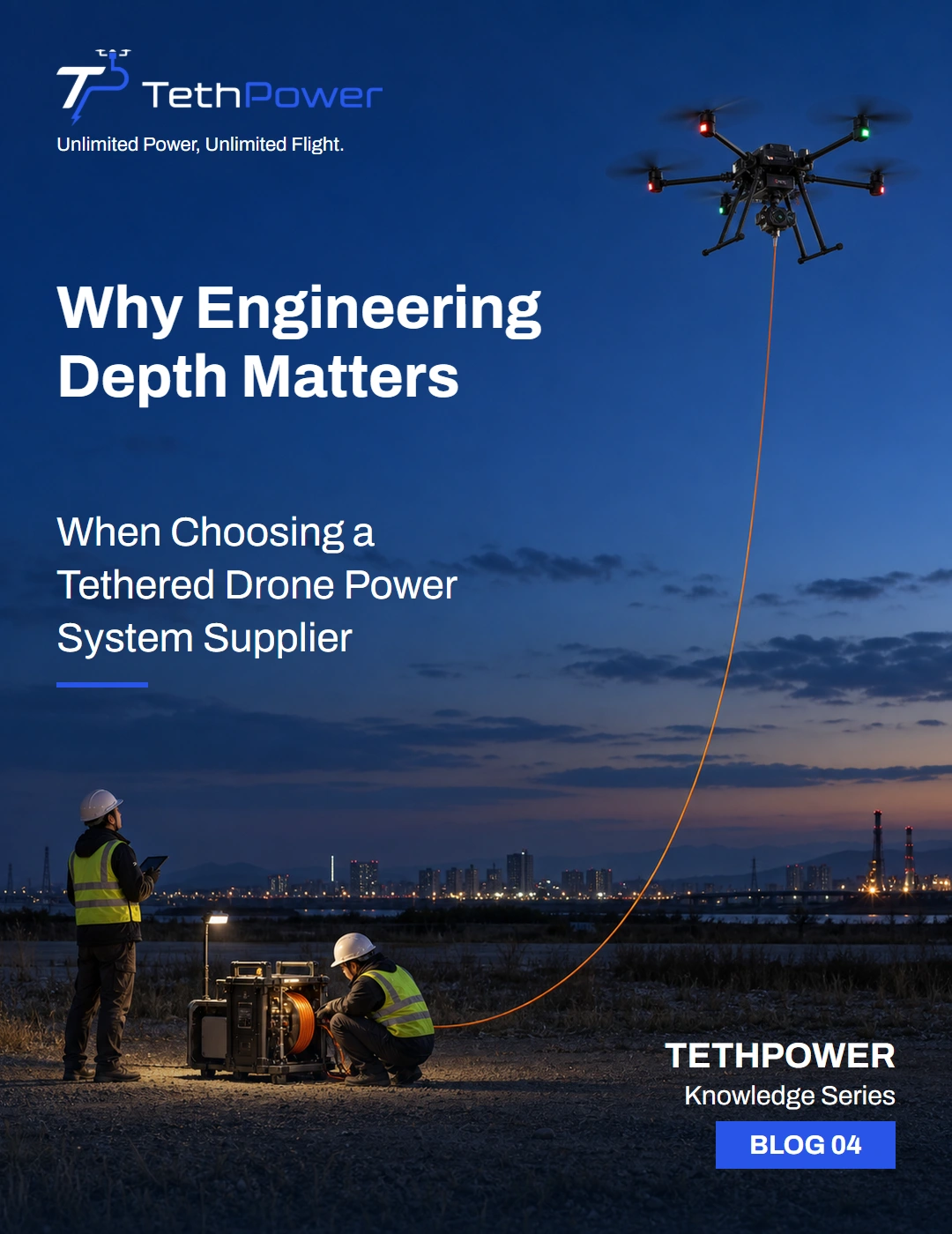
The core idea: A tethered UAV power system is not a power box plus a long cable. It is an integrated energy and mechanical system, and the quality of the engineering between components often matters more than the headline kW rating.
Tethered drone hardware can look deceptively simple from the outside: a ground unit, a cable reel and an airborne module. That visual simplicity hides a chain of engineering decisions. The supplier has to make ground conversion, high-voltage transmission, cable weight, airborne regulation, cooling and aircraft integration work together under a dynamic flight load.
For buyers, this means supplier selection should go beyond comparing brochures. A professional partner should be able to explain why a configuration fits a specific aircraft and mission - and also when it does not.
Tethered Power Is an End-to-End System
A typical architecture can be simplified as: AC input -> ground power conversion -> high-voltage DC transmission -> tether cable -> airborne DC/DC conversion -> UAV power bus and payload.
Every step influences the others. Increase tether length and voltage drop changes. Change aircraft voltage and the airborne conversion stage changes. Increase continuous power and cable conductor, thermal design and cooling margin may change. Add optical fiber and the tether, reel and interface architecture may change again.
What a Serious Supplier Should Understand
1. Aircraft electrical compatibility
The supplier should verify the aircraft battery-equivalent voltage, continuous load and peak demand before proposing the airborne module. “Close enough” voltage matching is not acceptable in an industrial power chain.
2. Cable optimization
A tether is both a conductor and an airborne mechanical load. Reducing resistance often means adding conductor material, but more conductor increases weight. The design task is therefore an optimization problem rather than a simple cable-size selection.
3. Thermal behavior under sustained load
Long-duration operation places sustained thermal stress on power electronics. Conversion efficiency, fan performance, enclosure airflow, ambient temperature and altitude all influence whether a system can maintain rated output for the intended mission.
4. Dynamic power demand
UAV loads are not static. Gust response, climb, acceleration and payload activation can create rapid power changes. The system needs adequate transient response and peak margin rather than relying only on a steady-state laboratory rating.
5. Integration boundaries
A good supplier should clearly state what is included and what remains the customer’s responsibility. For example, a tethered power supplier may provide ground power, cable, airborne conversion and interface support, while the UAV platform, payload, communications equipment or local certification may remain outside the supply scope.
How we assess your project: We review the engineering requirements first. We ask for the parameters needed to determine whether a system is viable before treating every inquiry as something that can be solved by a standard product. Clear technical boundaries are part of a reliable proposal.
Why Application Experience Matters
The same tethered power principles appear across different industries, but mission constraints change dramatically. A compact lighting UAV, a surveillance platform, a facade-cleaning drone and a heavy-lift emergency aircraft do not need the same power level, cable architecture or operating procedure.
We work across several tethered UAV application categories, including:
Portable and industrial aerial lighting.
Persistent surveillance and EO/IR monitoring.
Power-and-fiber tethered systems for wired data applications.
Drone facade and industrial cleaning systems.
DJI industrial-platform tethered integration.
UAV and lightweight eVTOL test power.
Higher-power emergency-response and heavy-load applications.
This application breadth is useful because it forces the engineering process to consider more than one ideal laboratory condition. Different missions expose different constraints: hose drag in cleaning, payload power in lighting, data stability in surveillance, thermal margin in long hover and high peak demand in heavy-lift platforms.
Why “World-Leading” Is Not a Technical Specification
Industrial buyers see many claims such as “leading manufacturer,” “best quality” or “advanced technology.” Those phrases are easy to write and difficult to verify. A better way to evaluate a tethered power supplier is to look for evidence in the engineering process: Are the right questions asked? Are continuous and peak power separated? Is tether loss discussed? Are environmental limits stated? Are supply boundaries clear? Are real integration cases available?
We prefer to build credibility through those details. A technically specific answer is more useful than a superlative.
What we aim to deliver
The goal is not to sell the biggest power box. The goal is to configure a power chain that the aircraft can actually use at the required height and under the expected conditions.
Mission-specific system matching rather than one-size-fits-all selection.
Clear separation of continuous power, peak power and environmental derating.
Ground station, tether and airborne module considered as one engineering chain.
Power-only and power-plus-fiber architectures according to the data requirement.
Integration guidance based on aircraft voltage, payload margin and mission equipment.
Clear communication about what is included, what must be confirmed and what is outside the supply scope.
A Better Question to Ask a Tethered UAV Supplier
Instead of asking only, “What is your maximum power?”, ask: “Can you show me how you would size the complete system for my aircraft, height and mission?” The quality of that answer tells you far more about the supplier than a single headline specification.
For us, that conversation normally begins with the same fundamentals: aircraft voltage, continuous power, peak power, MTOW, mission payload, tether length, environment and data requirement. When those inputs are clear, the hardware recommendation becomes much more meaningful.
FAQ
What is the most important capability in a tethered power supplier?
The ability to size and integrate the complete power chain for the actual aircraft and mission, rather than recommending hardware from nominal power alone.
Why should continuous and peak power be separated?
A UAV may hover at one power level but demand much more for short periods during takeoff, wind correction or payload activation. Both values affect sizing.
Why is cable engineering so important?
Cable resistance affects voltage loss, while cable mass affects the aircraft. The tether has to satisfy both electrical and mechanical constraints.
Do you only supply standard systems?
We use standard product families where they fit, but final configuration is matched to platform voltage, power, height, payload and mission requirements.
Talk to us
For a faster preliminary recommendation, send your aircraft model, battery voltage, continuous and peak power, required operating height or tether length, and destination country.
| Contact | Stella |
|---|---|
| Website | www.tethpower.com |
| stella@ | |
| WhatsApp / Tel | +86 177 1431 2943 |
TethPower | Tethered UAV Power Systems and Mission Equipment