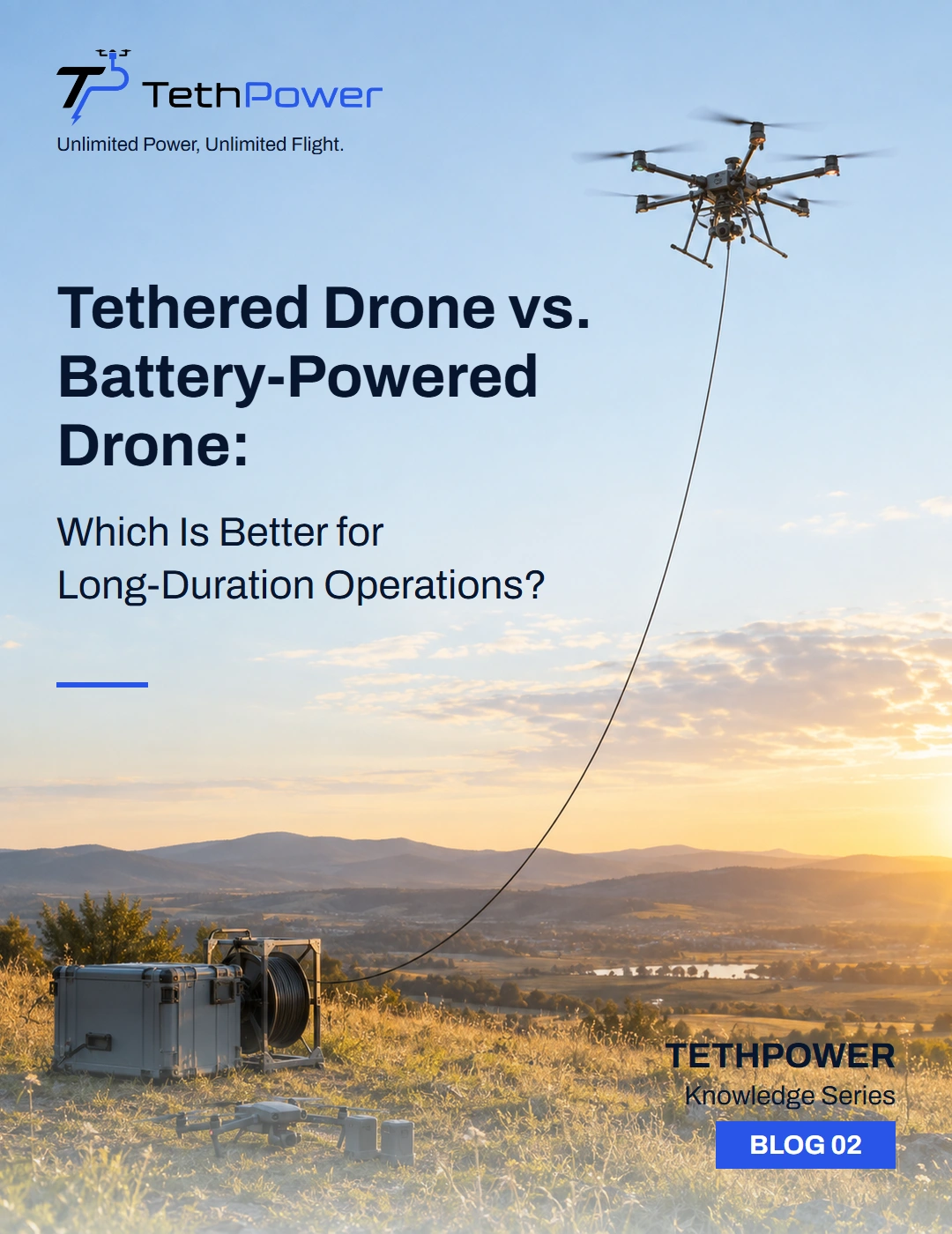
Short answer: Choose a battery-powered drone when mobility and range are the priority. Choose a tethered drone when the mission needs persistent presence, continuous power and a stable fixed-area operating envelope.
Tethered and battery-powered drones solve different problems. Asking which one is “better” without defining the mission is like asking whether a truck or a crane is better: both are useful, but they are optimized for different jobs.
Battery UAVs dominate mobile operations because the aircraft carries its energy onboard and can move freely. Tethered UAVs trade some of that mobility for persistent power and a controlled operating area. For long-duration missions, that trade can be exactly what makes the operation practical.
Side-by-Side Comparison
Scroll horizontally to read the full table
1. Endurance: The Biggest Difference
Battery-powered UAVs must carry their own energy. Even when spare batteries and charging equipment are available, long missions require repeated landing, battery replacement and relaunch. That cycle creates gaps in surveillance, lighting, relay or industrial work.
A tethered UAV receives energy continuously from the ground. This can transform a mission from a series of short sorties into a persistent aerial operation. The important word is persistent, not “infinite”: aircraft components, environmental limits and maintenance requirements still define the real operating window.
2. Mobility: Where Battery Drones Win
A tether physically limits the operating radius. That is a disadvantage when the aircraft must travel along a pipeline, map a large site or follow a moving target across kilometers. In those cases, a conventional UAV is usually the more efficient tool.
But many industrial missions do not need long horizontal range. A surveillance drone may need to watch one perimeter. A lighting drone may only need to hover above one work area. A cleaning drone may work section by section on one facade. For those missions, extreme mobility is less important than staying power.
3. Payload and Power: More Complicated Than It Looks
Tethered power does not remove the need for payload calculations. The aircraft still carries an airborne power module, connectors and part of the tether load. Engineers must confirm that sufficient payload margin remains after these items and the mission payload are installed.
The benefit is that the mission no longer depends entirely on the energy stored in onboard batteries. This can be especially valuable for high-consumption payloads such as lights, EO/IR systems, communication equipment, cleaning tools and industrial sensors.
4. Deployment and Ground Infrastructure
Battery drones are excellent for rapid short missions because they require little ground infrastructure. Tethered systems need a suitable power source, a ground power station and cable management. Higher-power applications may also require generators, three-phase input, larger reels or dedicated site planning.
For a 10-minute inspection, that additional setup may not be worthwhile. For a four-hour fixed-area mission, the setup can be justified by the reduction in repeated landing and battery management.
5. RF and Fiber-Optic Data
Most battery drones depend on RF links for control and payload data. This is perfectly suitable for many operations. Some environments, however, are RF-congested, sensitive or require a deterministic wired path for high-bandwidth payload data.
In these cases, a power-and-fiber composite tether can create a different system architecture: electrical power and optical data travel through the tether while the UAV remains aloft. We evaluate fiber as a mission requirement rather than adding it automatically to every system.
Our approach: Start with the mission, not the product. If the aircraft must move across a large area, battery power may be the better choice. If the aircraft needs to hold altitude over one area for a long time, tethered power deserves serious consideration.
If tethered operation fits your mission, check the seven power-system selection inputs before choosing equipment. You can then browse tethered power systems and components for the parts of the architecture you need.
Which Missions Favor Tethered UAVs?
Persistent security and infrastructure monitoring.
Emergency, construction and temporary aerial lighting.
Communications relay or elevated antenna missions.
High-rise facade and industrial cleaning.
Controlled UAV or lightweight eVTOL endurance testing.
Fixed-area emergency-response and high-power payload operations.
Which Missions Favor Battery UAVs?
Wide-area mapping and surveying.
Linear inspection of power lines, pipelines or roads.
Long-range photography and mobile observation.
Patrol missions requiring frequent horizontal relocation.
Short tasks where tether setup would add unnecessary complexity.
How we help define the right architecture
We do not treat tethering as the automatic answer to every UAV problem. The first step is to understand the aircraft voltage and power demand, required height, mission duration, payload margin, ground power, environment and data-link requirement. Only then can we determine whether a tethered architecture is technically and operationally justified.
This boundary matters. A good tethered system is not simply one that can power a drone; it is one that fits the mission better than the alternatives.
FAQ
Are tethered drones safer than battery drones?
They can offer a controlled operating envelope and continuous power, but safety still depends on aircraft design, site procedures, tether management, weather, redundancy and local regulations.
Does a tethered drone still need a battery?
Many architectures retain a backup or transition battery, but the exact design depends on the UAV and power system.
Can tethered drones fly long distances?
They are generally intended for fixed-area or limited-radius operations. For long horizontal travel, battery-powered UAVs are usually more suitable.
Can one UAV switch between battery and tethered operation?
Some platforms can be configured for both, provided the electrical interface, mounting, weight and operating procedures are properly engineered.
Talk to us
For a faster preliminary recommendation, send your aircraft model, battery voltage, continuous and peak power, required operating height or tether length, and destination country.
| Contact | Stella |
|---|---|
| Website | www.tethpower.com |
| stella@ | |
| WhatsApp / Tel | +86 177 1431 2943 |
TethPower | Tethered UAV Power Systems and Mission Equipment