
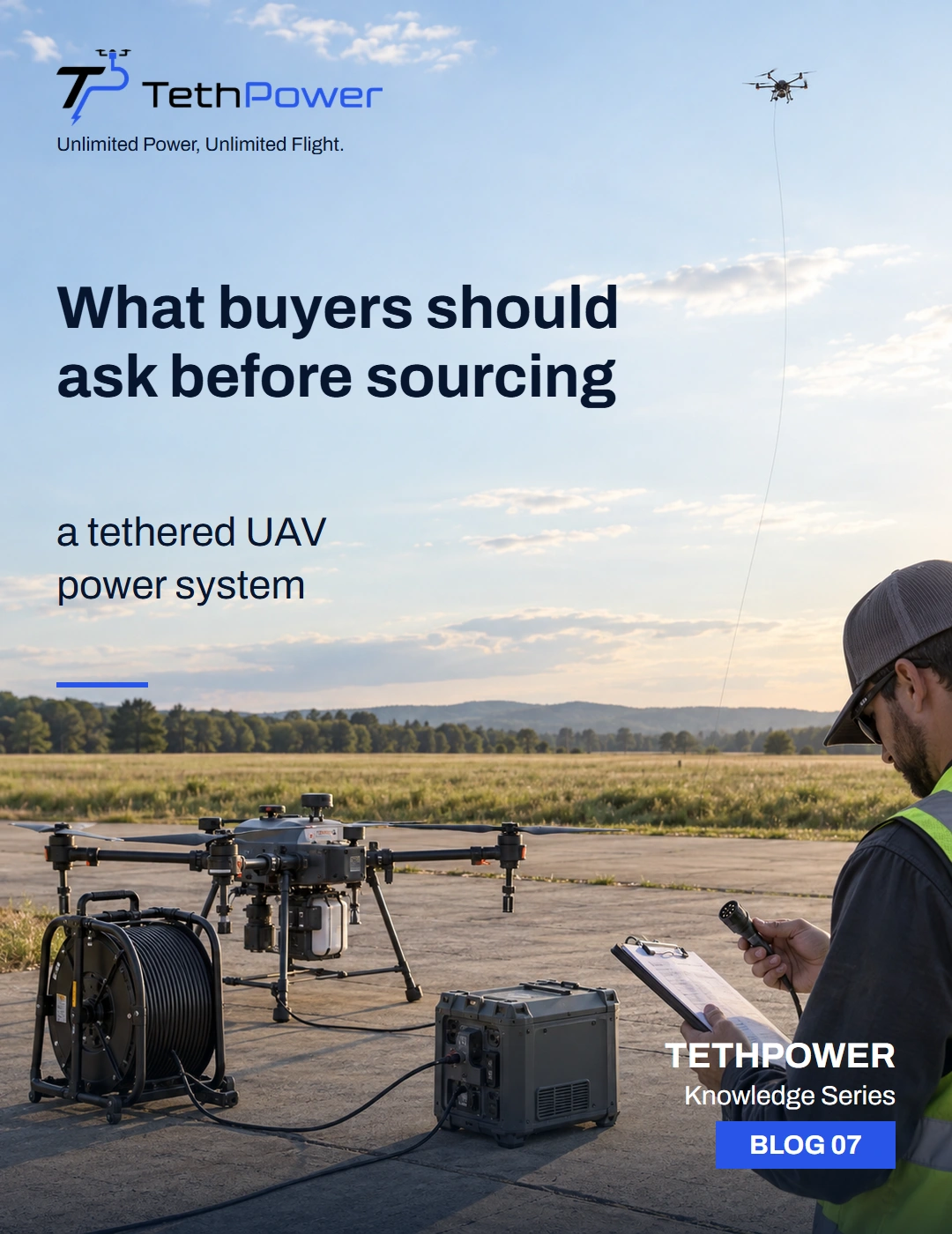
Comparing tethered systems only by maximum wattage can lead to the wrong selection. A buyer needs to evaluate the aircraft, payload, onboard conversion, ground station, tether, and operating environment as one power chain.
The following checklist helps create a technical and commercial comparison that can be confirmed before an order is placed.
1. Confirm the mission and aircraft platform
Provide the exact UAV model, payload, required height, duration, and operating environment. Aircraft with similar mass can use different voltages, connectors, and interfaces. Ask whether the quotation covers a complete kit or a component that still needs mechanical or electrical integration.
- Which aircraft models and revisions are supported?
- Which payload was included in the power calculation?
- Which components are standard, optional, or supplied by the buyer?
2. Compare continuous power, not only peak power
Request the continuous input and output ratings for every stage. Check the ground input, tether transmission voltage, onboard output, and the combined demand of the aircraft and payload. Ask what operating margin is included and under which thermal conditions the stated continuous rating applies.
- Continuous rating and short-duration maximum rating.
- Input and output voltage ranges.
- Protection functions, cooling method, and temperature limits.
3. Review the tether and its management
Tether length affects operating height, suspended mass, and electrical drop. Confirm the usable length, material, mass, voltage rating, and connectors. If a reel or winch is included, request its payout mode, recovery speed, controls, and emergency procedure.
- Usable length, mass, and rated voltage.
- Passive payout, active recovery, and maximum rewind speed.
- Procedure for obstruction, power loss, or landing.
4. Check interfaces and documentation
Review connectors, polarity, grounding, control signals, and mechanical integration. Ask for the manual, connection diagram, packing list, and datasheet for the exact offered configuration. General family data should not replace model-specific values.
If the system communicates with the aircraft or payload, identify the protocol, software requirements, and responsibility for integration. Document any adapter or aircraft modification before approving the order.
Use the product manuals by model to review the documentation currently available. Confirm that the manual, product version and proposed configuration match before relying on a specification in your comparison.
5. Define the operating environment
Confirm how altitude, ambient temperature, enclosure, ventilation, and installation affect the configuration. The aircraft manuals determine flight limits, while the ground station and cable may have separate environmental limits. Request the applicable values rather than assuming that one component's rating covers the whole system.
6. Close the commercial scope
Before payment, confirm the configuration, included accessories, current lead time, warranty terms, packing, shipping method, and import responsibilities. For customization, record the required interfaces and acceptance criteria in writing.
- Model and revision of each component.
- Complete list of included and optional items.
- Lead time, commercial terms, and shipping method.
- Documents and checks supplied with the equipment.
Information for our recommendation
Send the aircraft model, payload, voltages, continuous power, operating height, duration, ground input, environment, and destination country. With these details, we can review a specific configuration instead of returning a generic estimate.
For an initial inquiry, copy these fields and mark unknown values as "unknown": aircraft model/version | aircraft DC bus or battery voltage | continuous and known peak power | mission payload | working height and tether length | available ground AC input | site altitude and temperature | power-only or power-and-data requirement | requested components. You can compare onboard conversion modules and ground power stations separately before discussing a complete configuration.
Product support and enquiries
We manufacture tethered UAV power systems and support project-specific system integration and customization.
| Contact | Stella |
|---|---|
| Website | www.tethpower.com |
| stella@ | |
| WhatsApp / Tel | +86 177 1431 2943 |