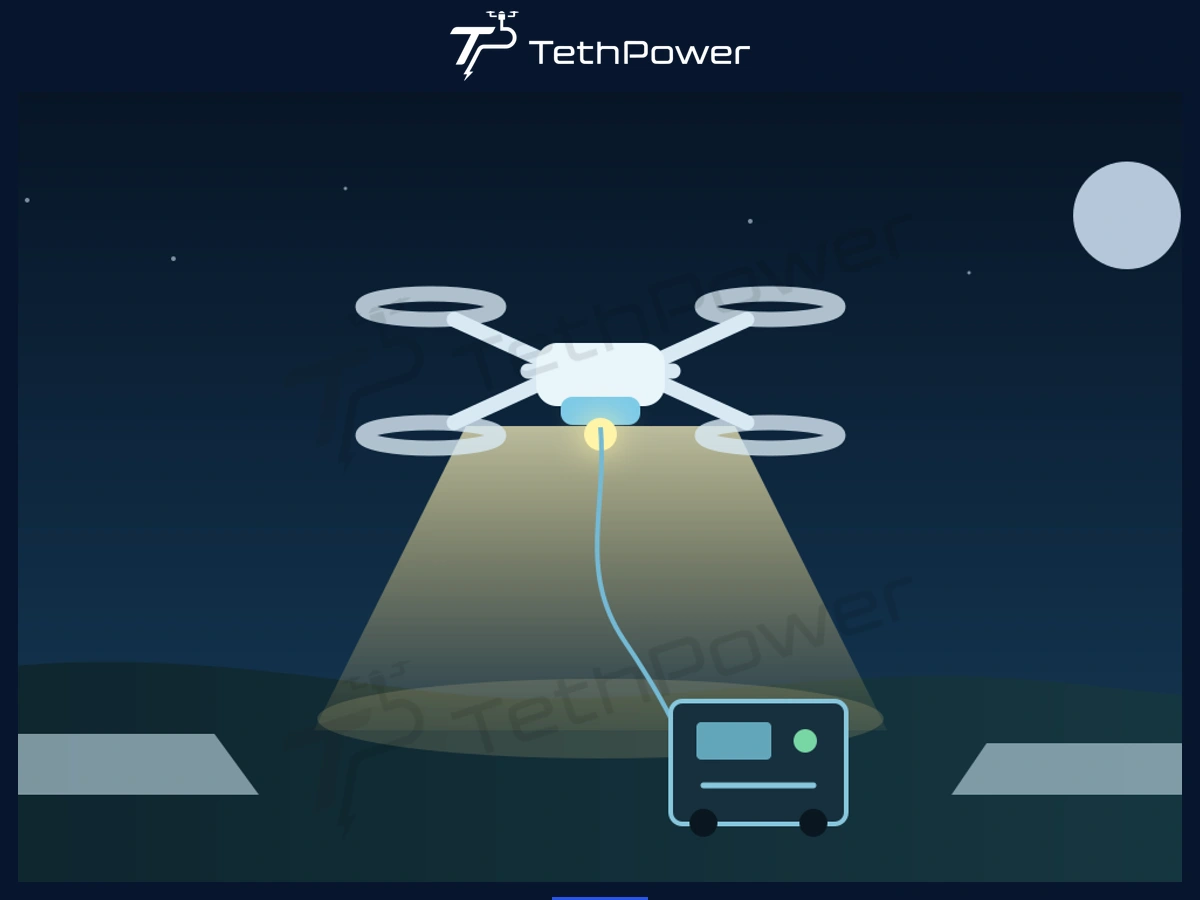
Quick answer: This 249g-class tethered lighting drone lifts a high-brightness LED up to 10 m above the work area. It delivers up to 15,000 lm, supports automatic takeoff/landing and cable retraction, and can operate for more than 24 hours from a suitable ground power source.
Why Use an Elevated Tethered Light Instead of Another Ground Lamp?
Temporary night work is often less about maximum lighting power than about getting usable light into the right position quickly. Tripods and light towers work well at fixed sites, but vehicles, vegetation, uneven terrain, water, buildings or crowd movement can block their beam and create heavy shadows. An elevated light changes the angle: the source is raised above many ground obstacles while the power supply remains on the ground.
Our portable tethered lighting configuration is intended for locations where teams need a compact, movable overhead light without repeated drone battery swaps. It is not designed to replace every conventional light tower; it fills the gap between handheld/ground lighting and larger fixed lighting equipment.
System at a Glance
Scroll horizontally to read the full table
How the Portable Tethered Lighting System Works
Place the compact ground station near the work area and connect the selected power source.
Launch the lighting drone through the control interface. The tether pays out as the aircraft climbs.
Raise the LED to the required working height, up to 10 m, so the light can illuminate the area from above obstacles.
Keep the aircraft supplied from the ground station for extended operation instead of relying only on onboard battery endurance.
At the end of the task, use automatic landing and automatic cable retraction for a cleaner pack-down.
Where This Solution Fits Best
Scroll horizontally to read the full table
Key Design Advantages
Lightweight airborne unit - the 249g-class aircraft is easier to transport and deploy than larger industrial tethered platforms.
Elevated illumination - up to 15,000 lm is positioned above the work area rather than at ground level.
Long-duration ground power - more than 24 hours of operation can be supported when the ground source and site conditions are suitable.
Low-handling workflow - automatic takeoff, landing and cable retraction reduce repetitive manual handling.
Flexible site power - battery-powered and AC-powered ground configurations can be selected for different deployment environments.
Mobile role, not a fixed tower role - the system is best used where frequent repositioning, compact transport or difficult ground geometry matters.
What to Confirm Before Selecting a Configuration
Required illuminated area and desired light level
Target flight height and local obstacles
Expected continuous operating time
Available AC supply, generator or portable battery source
Typical wind, temperature and site altitude
Quantity of systems and whether multiple independent lighting points are needed
Frequently Asked Questions
What is a portable tethered lighting drone?
It is a compact UAV lighting system that holds an LED above the work area while receiving power through a tether from a ground unit. The elevated position improves the lighting angle for temporary night operations.
How long can the system stay in the air?
The reference configuration supports more than 24 hours of ground-powered operation. Actual mission duration depends on the selected ground power source, environment and operating procedure.
How high can it fly?
The reference configuration supports up to 10 m of flight height.
How bright is it?
Lighting output is up to 15,000 lm.
Does the tether need to be wound by hand?
No. The reference system includes automatic cable retraction.
Can it replace a light tower?
Sometimes, but not universally. A conventional tower can be better for a large fixed worksite. A tethered lighting drone is more attractive when the site is temporary, mobile, obstructed or difficult to access with heavier equipment.
Can the ground station use battery power as well as AC?
Yes. Battery-powered and AC-powered configurations are available depending on the selected ground unit.
What information is useful for a quotation?
Share the application, lighting area, target height, operating time, available power source, environment and quantity. That is enough to start configuration selection.
Talk to us about your configuration
Tell us the required lighting area, flight height, operating time and available power source. We can recommend a portable tethered lighting configuration around the mission rather than forcing a fixed package.
| Contact | Stella |
|---|---|
| Website | www.tethpower.com |
| stella@ | |
| WhatsApp / Tel | +86 177 1431 2943 |