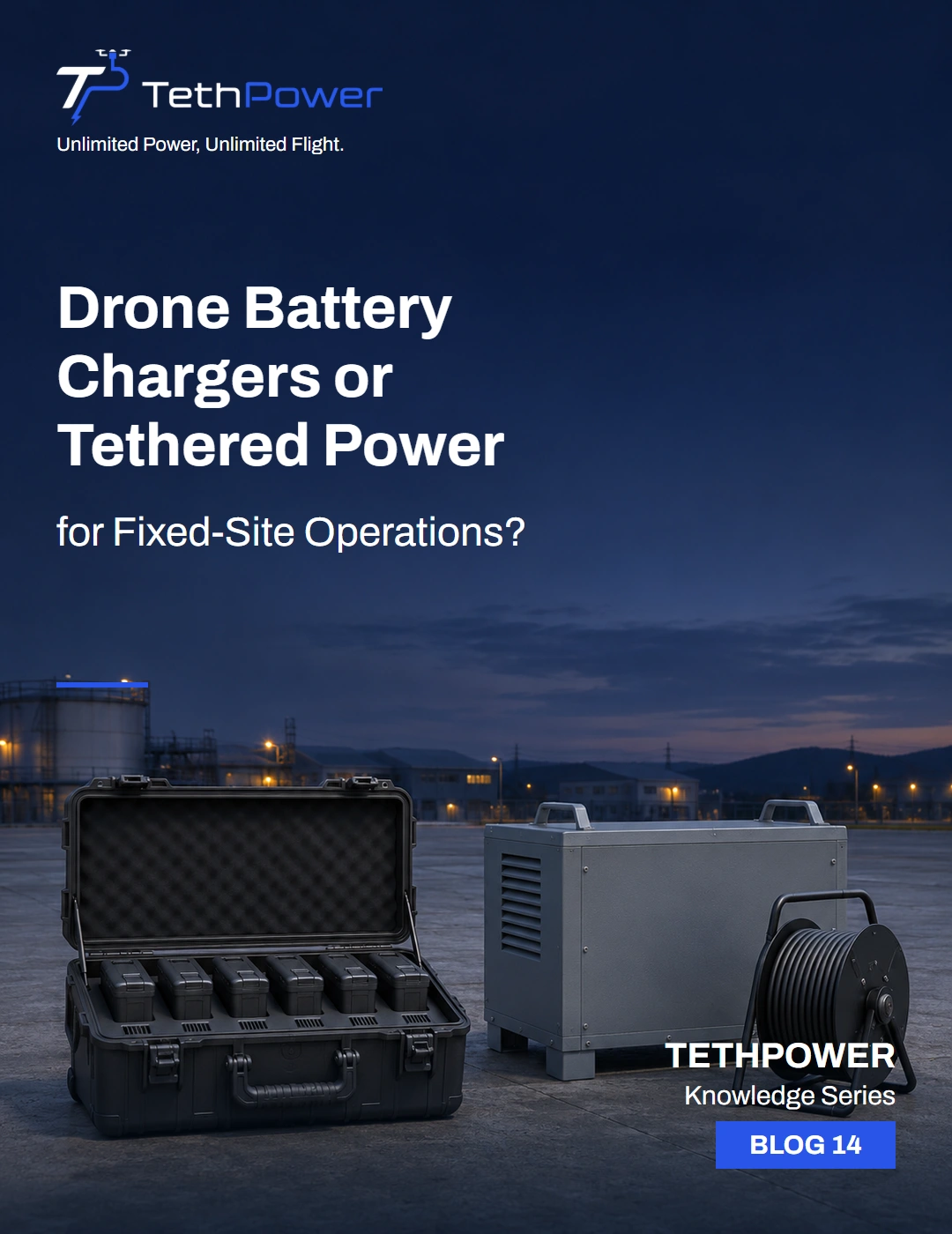
For a fleet that returns to the same site shift after shift, a multi-bay drone battery charger and a tethered ground station solve different parts of the job. Choose which equipment to buy by asking where the aircraft has to work, how often battery changes interrupt useful coverage, and what the site can power. A mixed fleet can keep chargers for mobile missions and add tethered power for a recurring fixed-site assignment.
What would each option change in a shift?
With battery rotation, aircraft fly on one set while other sets are prepared. Count landing, battery change, checks and return to the task. If another aircraft maintains coverage in the meantime, include its equipment and crew in the comparison. A busy charger only helps if the next set is ready when the schedule needs it.
In a tethered configuration, a ground station receives AC and sends power through a tether to a compatible onboard module. It can reduce routine swaps for one assignment within a usable tether area. Setup, recovery and inspections still take time, and the aircraft, payload, weather and maintenance continue to limit the job. Retain a charging plan for any batteries the configuration keeps.
Scroll horizontally to read the full table
Check which equipment can share the site supply
For charging, use the maker's documented input and the number of units expected to charge concurrently. List site loads that run at the same time. The number of bays alone does not tell you whether the charger fills all batteries at once or what it draws.
For the ground station, record the required AC voltage, phase and frequency, then check the power available at the connection and the loads sharing it. If you plan to use a mobile power station or generator, compare its documented AC output with the station requirements and the operating conditions. Maximum ground output does not tell you average energy use or size a generator by itself. See our ground station AC supply guide for the inputs to collect.
Our TP-T4 lists 220 VAC input, 400 VDC output with 30 V compensation, 4 kW maximum ground output and a 110 m tether. The TP-T12 lists 380 VAC three-phase input, 800–1000 VDC output, 12 kW maximum ground output and a 120 m tether, with recommended onboard power of no more than 12 kW. Each system needs a project review of the aircraft, payload, module, interfaces and tether route. Tether length on the reel does not establish operating height. Follow the equipment and aircraft instructions and the site rules.
Compare purchases against one representative assignment
Use the same period, currency and coverage target. List what you would keep, add or replace in each option. Allocate the costs of shared equipment to the assignment on the same basis. Include energy, crew, transport, inspections and consumables. Account for the chargers and batteries still in use, as well as any equipment needed to cover handovers. Ask what each quotation includes so omitted hardware or integration costs remain visible.
Work out the total comparable cost per hour of useful coverage from your logs. Track unplanned interruptions separately, and count the cost of coverage gaps only once. If you have battery logs but have not measured tethered setup and recovery, leave those times as trial inputs. Our cost-per-hour guide has a worksheet for the calculation.
Decide what to keep after a trial
For a recurring fixed-site job, a trial can show whether to keep the current rotation, add tethered capability for that job or make it the primary power arrangement at the site. Measure setup, recovery, actual coverage and energy with the intended payload and duty cycle. Use the real crew and access route, and compare results with the existing rotation over similar work. If a second aircraft already covers battery changes, include its coverage in the baseline.
Tell Stella about one representative shift, including your aircraft and payload, how long the work stays at one location, the battery rotation and the site supply. We can discuss whether tethered ground power is worth evaluating and which equipment and interfaces to include in a comparable quotation.
Product support and enquiries
We manufacture tethered UAV power systems and support project-specific system integration and customization.
| Contact | Stella |
|---|---|
| Website | www.tethpower.com |
| stella@ | |
| WhatsApp / Tel | +86 177 1431 2943 |