The decision
Size the fill from the carrier maker's payload allowance, the 4 kg bucket and the rigging. The 100 L figure is the bucket volume, not the load every carrier can lift.
Bucket volume is not carried load
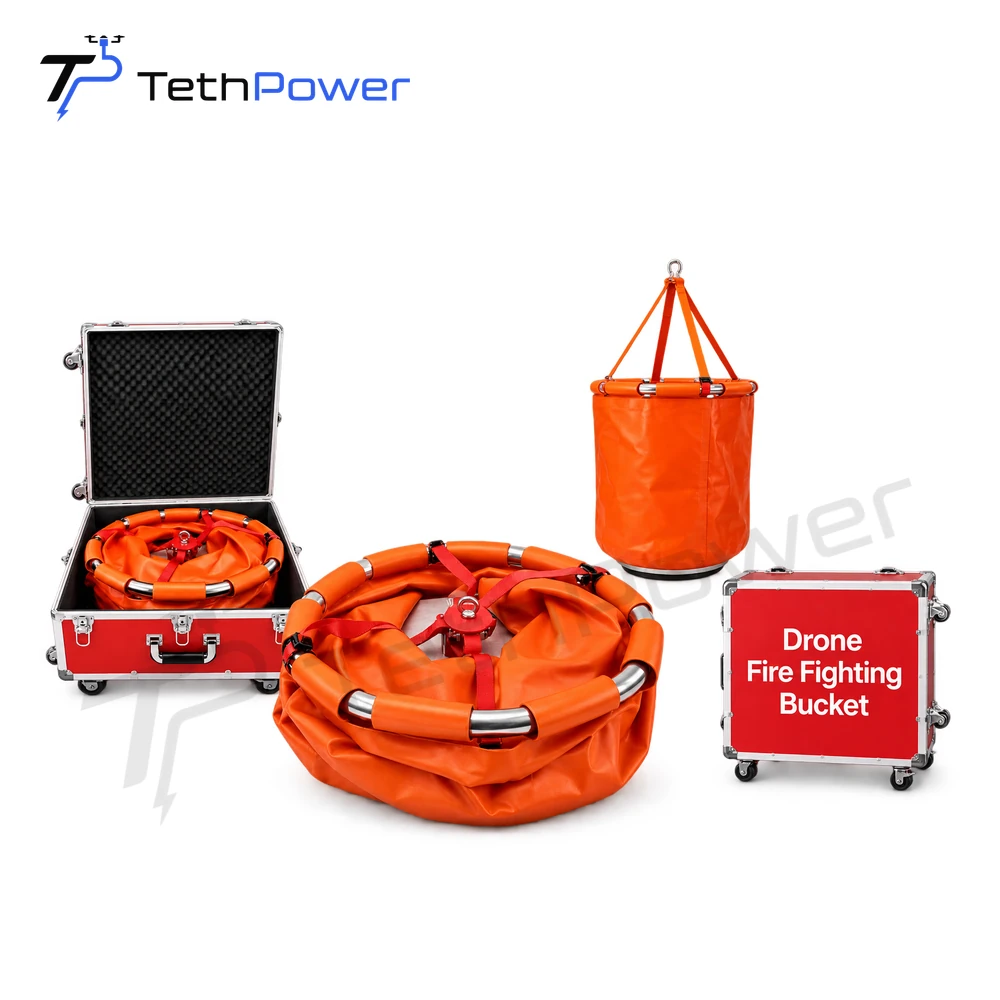
If you quote a firefighting bucket, the usable fill is a different number from the volume printed as capacity. The TP-FC100-FFB is a 100 L aerial firefighting bucket with a 4 kg bucket weight, for DJI FC100, T100S, FC30 and compatible third-party carrier aircraft. That 100 L is the volume of the bucket. It does not state how much of that volume a particular carrier may lift.
Our guide to a carried bucket and hose-fed equipment separates those two ways of bringing water to the aircraft. This guide stays with the carried bucket and turns a carrier’s payload allowance into a fill. We supply the bucket as an accessory. A bucket mission does not by itself require a tethered power system, and capacity or discharge figures do not establish extinguishing effectiveness.
The fill budget, in words and symbols
Start from the allowance the carrier maker states for the carried assembly, then subtract what is not water.
Water mass = carrier payload allowance for the carried assembly − bucket mass − rigging mass.
Water volume = water mass ÷ agent density.
Use the allowance that applies to the carried assembly on that carrier. This guide does not insert an example allowance, so no sample number here can be read as a pairing with a named carrier.
Rigging mass is the mass of the suspension and fittings that travel with the bucket and are not already inside the 4 kg bucket weight. If that mass is not yet known, mark it as an open item in the enquiry rather than setting it to zero.
What a full 100 L bucket weighs
Water is about 1 kg per litre. That is a general physical value, not a result from our product tests. A full 100 L fill is therefore about 100 kg of water, plus the 4 kg bucket, before rigging.
Add the rigging on top of the water and the bucket. That sum is what the carrier lifts for that fill, and it still has to sit inside the carrier maker’s allowance for the carried assembly.
Agents of different density
The TP-FC100-FFB supports water, fluoroprotein foam and aqueous extinguishing agent. The same volume does not have the same mass when the agent is not water. Keep the agent’s density with the fill calculation, and do not reuse the figure of about 1 kg per litre for foam or another agent.
A change of agent is a different fill. Talk to our sales team before you treat a water budget as valid for another agent.
Where the allowance comes from: the carrier maker’s data
The payload allowance comes from the carrier maker’s data for that aircraft and the carried assembly. We do not publish a substitute allowance, and a figure from one carrier is not the allowance for another. DJI FC100, T100S and FC30 are the platforms named on the product page. A third-party carrier needs its own review.
Ask the carrier maker for the allowance that applies when the bucket, the intended fill and the rigging are carried together. An allowance stated for a different load arrangement is not yet the allowance for this bucket.
What to send us for a carrier review
Send the carrier model, the payload allowance and the conditions stated with it, the intended agent, the fill you want to quote, and what you know about rigging mass. Include the mounting arrangement if you already have one.
Our sales team confirms the carrier review, the fill and any change of agent for your project. Pricing, lead time and commercial terms are confirmed with our sales team as well. For the equipment list to attach to that enquiry, use the quotation checklist. Where the scope is still a choice between a complete package and separate components, see complete system or components.