At a glance
With our TP-FlyCart 100, you can evaluate external power for work within a defined tethered area. You supply the aircraft. Build your commercial case around the site and complete operating cost before quoting the power kit.
Qualify the site before you quote the kit
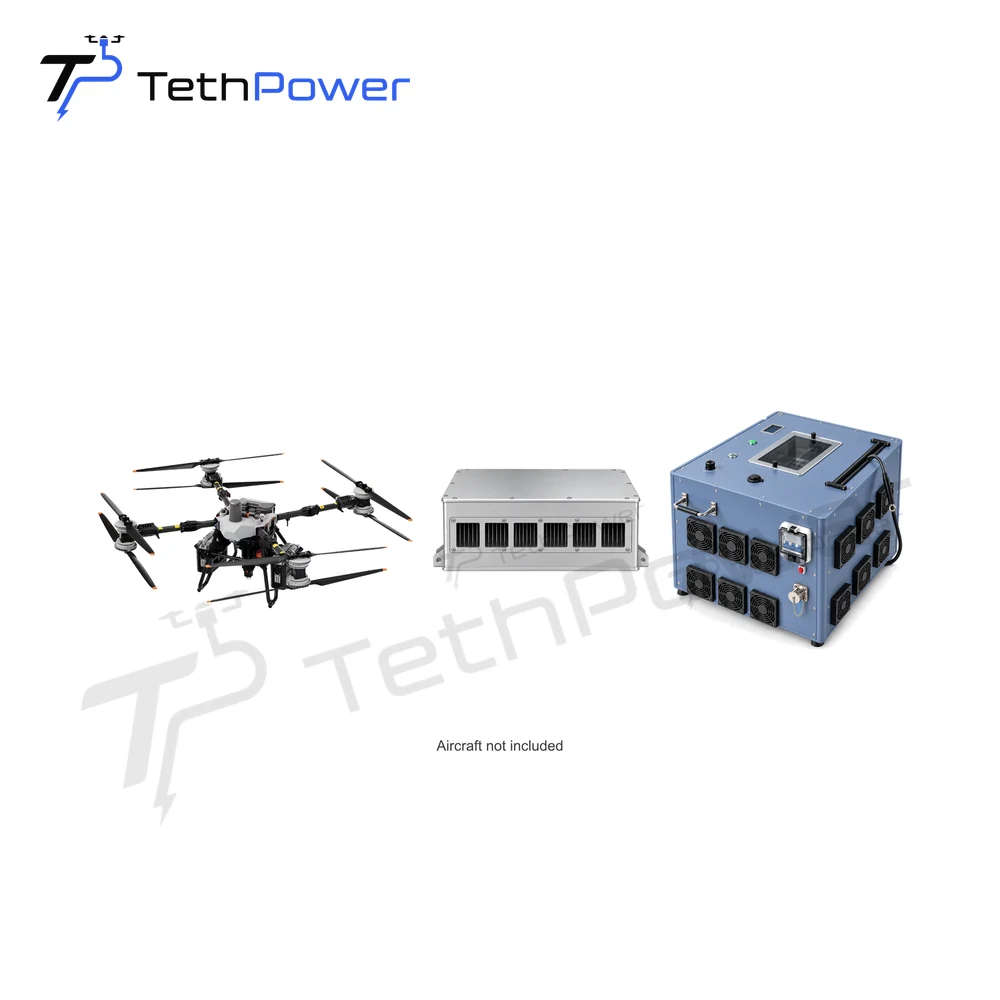
If you supply equipment for lifting or transport around a fixed site, tethered power may offer another use for an aircraft your customer already owns. Our TP-FlyCart 100 supplies the power kit for a customer-provided DJI FlyCart 100; the aircraft is not included. The operating area and cable route determine whether it suits the job.
Plan a suitable three-phase AC 380 V supply and access for the ground equipment. You have a 120 m cable, which you must route with allowance for the ground section, clearance and operating geometry. You must not treat cable length as a guaranteed flight height or plan a free-ranging delivery route around it.
Keep your complete installation in the calculation
Our TP-T25 ground station provides up to 25 kW; our TP-P22 airborne module provides a maximum of 24 kW. You need to assess the complete power chain, cooling, aircraft configuration and working load together. You cannot allocate the full ground-station rating to an additional payload.
Our manual states tethered flight duration of ≥12 h. For your project, you still need operating limits, inspections, crew arrangements and a reliable ground supply. You should not use that duration as a promise of uninterrupted paid work. Confirm your aircraft version and its limits with us before relying on aircraft reference figures from another region.
Sell a defined project scope
As a dealer or integrator, you can consider the power kit alongside site assessment, integration coordination and a commissioning demonstration within your capabilities. You can price this work separately so your offer reflects the preparation required. We can review the equipment scope with you; contact sales for pricing, delivery, spare parts and support terms.
Your quotation should cover:
- Your aircraft, power kit, suitable electrical supply and transport arrangements.
- Your installation checks, cable management, crew time and supervised trial.
- Your acceptance task, maintenance allowance and plan for weather or power interruptions.
Compare the cost of an equivalent completed task
Use the same working area, load and completed output when comparing tethered and battery operation. Record your setup, battery handling, energy use, staffing and equipment movement. You can then assess whether fewer battery-change interruptions compensate for the extra ground equipment and preparation at your site.
Use our operating-cost guide to compare costs for your site; margin and payback depend on your own work. Tell Stella your aircraft version and the task you have in mind. We can discuss the operating area, load and available power, including a separate compatibility review if you plan to add a cleaning hose or firefighting bucket.