
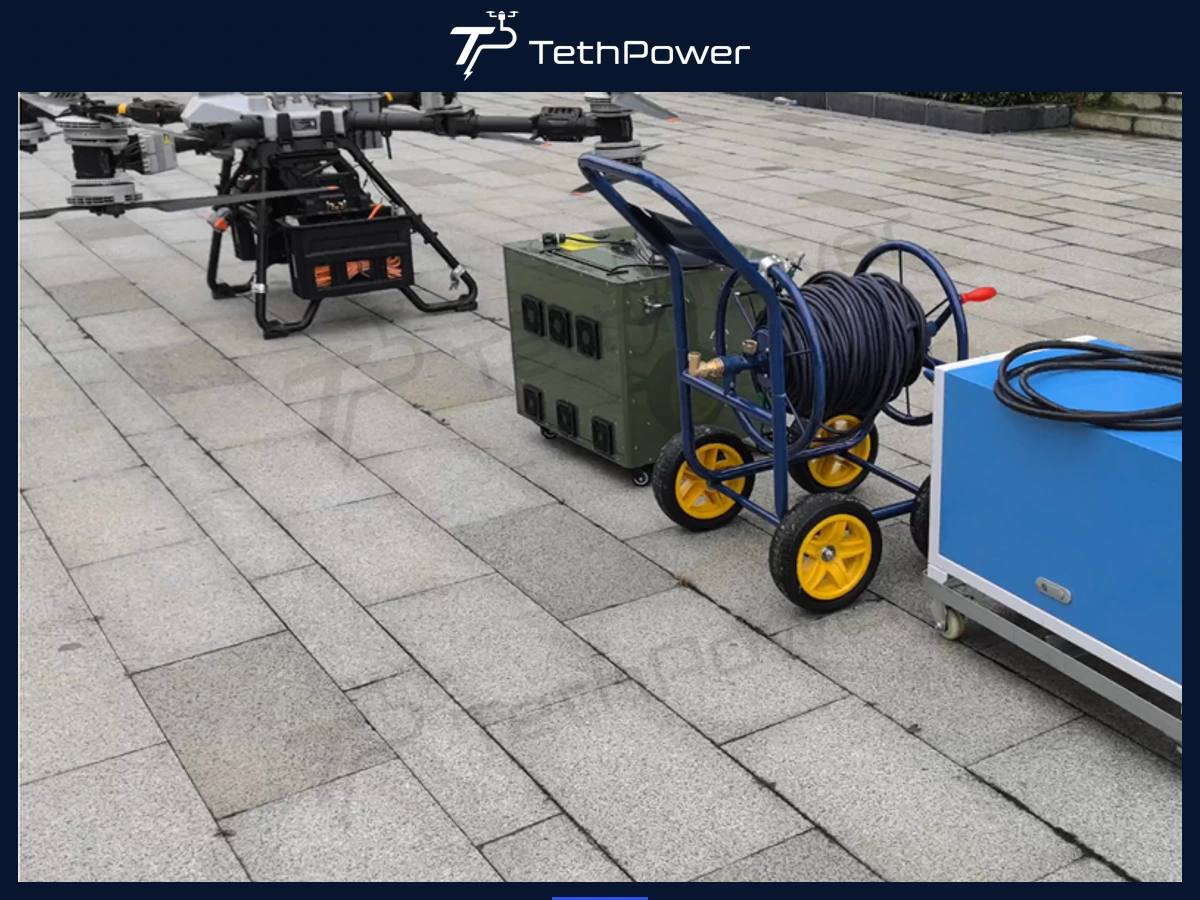
Reference note: This page analyzes a completed historical DJI FC100 facade-cleaning deployment as an engineering reference. The recorded project data is useful for system design, but it should not be treated as a universal specification or performance guarantee. New projects should be recalculated around the actual building, aircraft, hose length, power source, water requirements and operating environment.
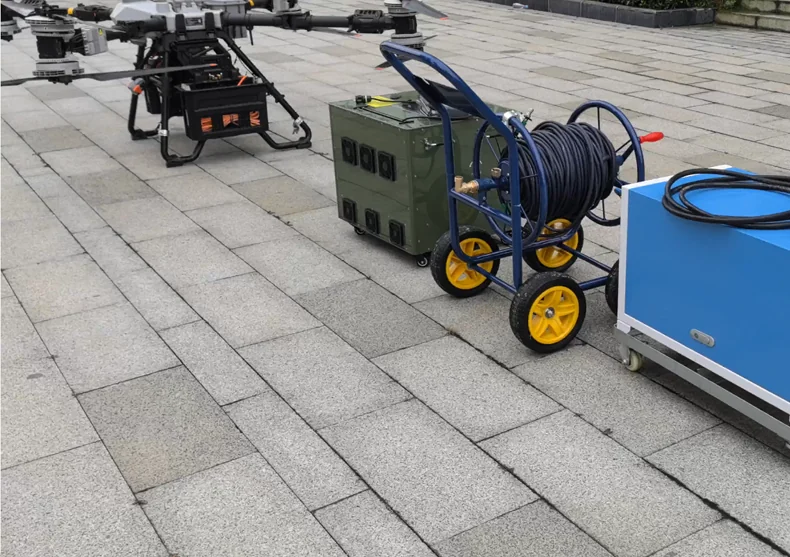
Reference field configuration: tethered power equipment, cable reel and high-pressure water system.
Facade cleaning with a heavy-lift UAV is not simply a matter of adding a spray lance to a drone. Once the aircraft must stay airborne for long periods while also receiving a continuous water supply, the project becomes a combined power, fluid-delivery, payload and tether-management problem. The reference FC100 deployment used two independent ground-fed service paths: a high-voltage electrical tether for continuous aircraft power and a separate high-pressure water hose for cleaning fluid.
The value of the dual-tether architecture is not that it removes every operating limit. Its value is that it moves the two largest endurance constraints - electrical energy and cleaning water - from the aircraft to the ground. This changes how the complete system must be sized and how the cleaning workflow is planned.
1. Why FC100 Facade Cleaning Is a System-Engineering Problem
A battery-only heavy-lift drone must return for battery replacement or charging. An aircraft carrying a large onboard water tank also consumes payload very quickly and must return for refilling. A ground-fed cleaning architecture addresses these two constraints separately:
Scroll horizontally to read the full table
Because both lines are carried by the aircraft, neither path can be engineered independently. Longer working height increases electrical tether weight and voltage-drop exposure while simultaneously increasing hose weight and hydraulic losses. The correct design therefore starts from the complete mission rather than from a single product model.
2. Start With the Airborne Payload Budget
For an FC100 cleaning project, the aircraft payload margin has to cover more than the visible cleaning tool. The airborne budget can include the power-conversion module, spray lance, water hose, fittings, cable/hose attachment hardware and mounting structure. The aircraft must still retain adequate margin for stable operation in the intended wind and maneuvering conditions.
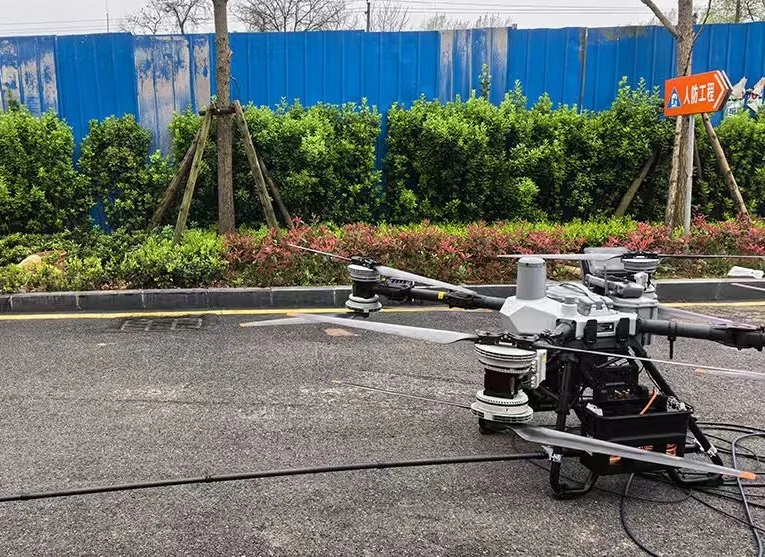
DJI FC100 platform configured for the reference dual-tether cleaning project.
- Reference FC100 aircraft data used for the project: 55.2 kg aircraft weight in lifting configuration, excluding batteries.
- Reference maximum takeoff weight: 149.9 kg.
- Reference maximum payload: 80 kg in single-battery mode and 65 kg in dual-battery mode.
- Reference hover wind resistance: 12 m/s.
These values describe the platform information used for this reference. They do not replace a project-specific payload calculation. In practice, increasing operating height can add significant suspended hose and tether weight even when the airborne hardware itself remains unchanged.
3. Engineer the Electrical Path Around Length, Weight and Voltage Drop
The electrical side of the reference system used a ground power unit that converted 380 V three-phase AC into adjustable high-voltage DC for transmission through a lightweight tether. An airborne converter then reduced the tether voltage to the aircraft-side DC bus.
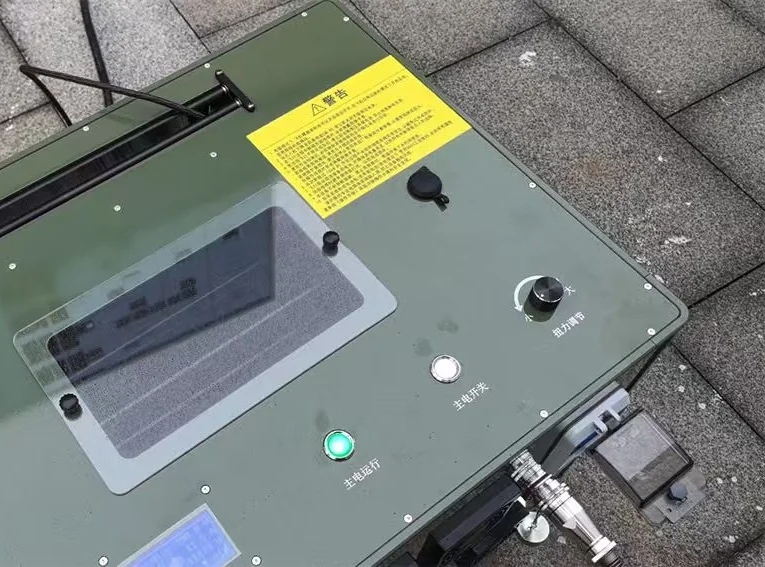
Ground tethered power unit used in the reference cleaning deployment.
Scroll horizontally to read the full table
The reference enclosure used FR4 non-conductive fiberglass composite and listed 15 kV/mm dielectric strength. Cable handling was supported by a motorized reel, guide pulley and anti-static brush.
Airborne conversion reference
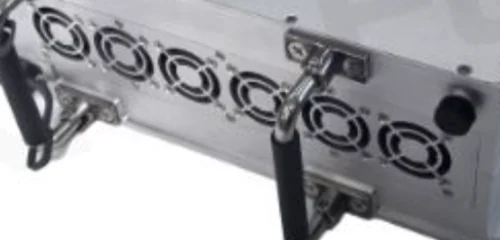
Reference airborne DC/DC power module - front cooling and connector detail.
Scroll horizontally to read the full table
The 400 A figure is a current limit, not a published continuous-current rating. We do not publish a continuous or peak output-power rating for this reference airborne module, so those values should not be inferred from the current limit alone.
4. Treat the Water Circuit as a Separate Engineering Calculation
Pump pressure at ground level is not the same as pressure at the airborne nozzle. Working height, hose length and diameter, fittings, target flow and nozzle selection all influence the pressure that actually reaches the facade. For this reason, a cleaning project should specify the required pressure and flow at the working point, not only the maximum pressure printed on the pump.
Reference spray-lance data
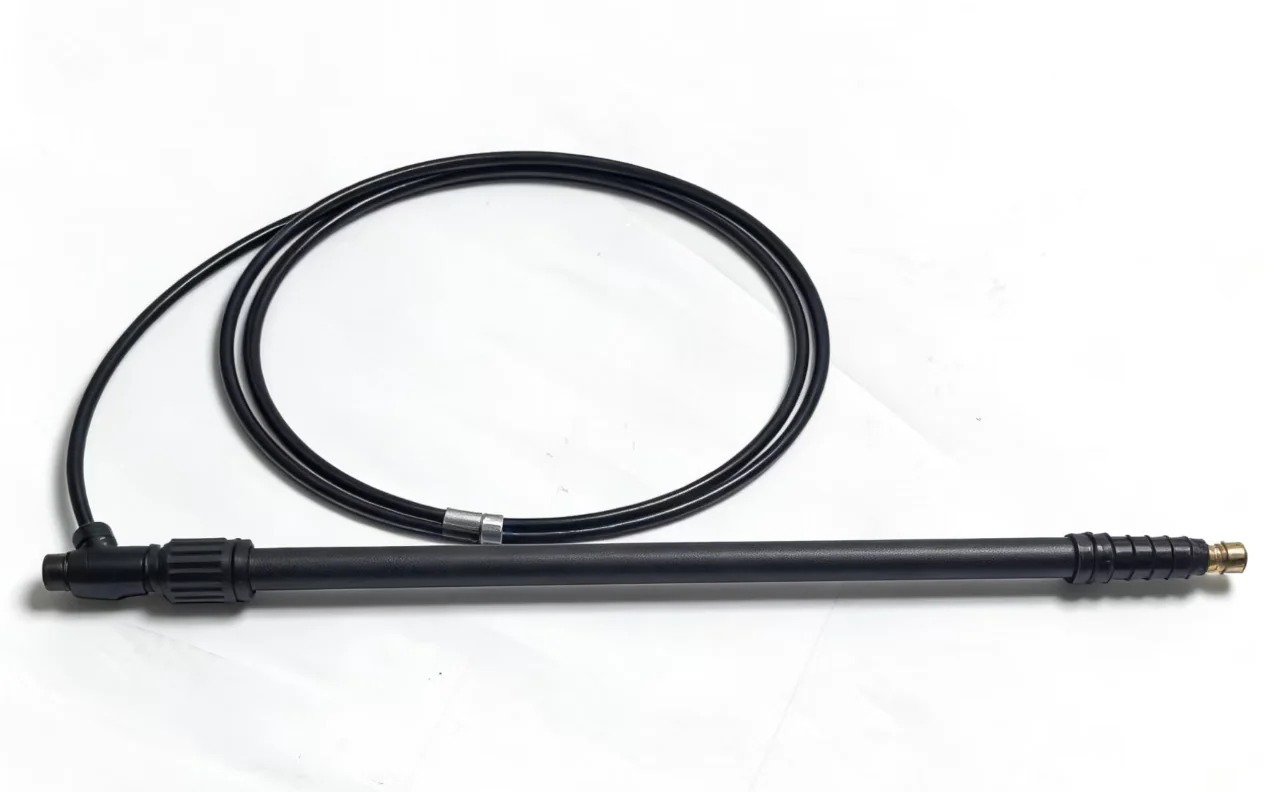
Telescopic airborne spray lance used for close-range facade washing.
Scroll horizontally to read the full table
Current pump reference for new configurations
For current project discussions, KH9 is the replacement ground pump configuration associated with this reference solution. It should not be assumed to be the exact pump shown in historical project photographs.
Scroll horizontally to read the full table
5. Cable and Hose Management Affect Flight Behavior
A dual-tether cleaning drone is influenced by two suspended lines rather than one. Their weight, drag, bend behavior and attachment geometry can affect positioning near the facade. The system therefore needs controlled pay-out and rewind as well as a practical routing method that reduces slack, snagging and unwanted side loads on the aircraft.
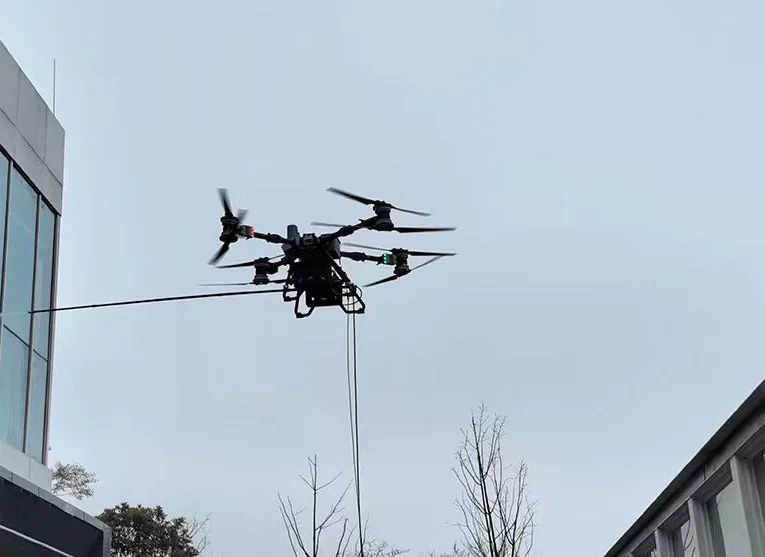
Reference on-site facade cleaning operation.
This is also why maximum building height should not be treated as a simple “cable length” question. A 300 m reference configuration does not mean the same hardware can automatically be used on every 300 m building. Electrical voltage drop, suspended cable mass, water-hose pressure loss, hose mass, local wind and the aircraft payload budget all need to be reviewed together.
6. Historical Reference Results - Useful for Benchmarking, Not Guarantees
Scroll horizontally to read the full table
These results belong to one specific deployment. Actual cleaning productivity can change materially with facade geometry, contamination level, detergent/chemistry, nozzle selection, stand-off distance, water source, hose length, wind and operator procedure. The same applies to working pressure and operating duration.
7. Five Engineering Lessons From the Reference Architecture
Power and water must be sized together. Increasing height affects both the electrical and hydraulic paths. A longer tether adds suspended mass and voltage-drop exposure; a longer hose adds suspended mass and pressure loss.
Payload margin is a system budget. The power module, lance, hoses, fittings and mounting structure consume payload before the cleaning task begins. The design should preserve operating margin instead of sizing only to the aircraft maximum.
Pump-side pressure is not nozzle pressure. A project that specifies only a pump rating is incomplete. The required pressure and flow at the facade should drive hydraulic selection.
Continuous power changes the bottleneck. Once battery exchange is no longer the main interruption, water supply, hose management, aircraft inspection, cleaning route planning and crew procedure become the next practical limits.
Reference hardware must be recalculated for the building. Building height, facade shape, wind corridor, water source, available AC supply and local operating constraints can all change the appropriate configuration.
8. When a Dual-Tether FC100 Architecture Makes Sense
The architecture is most relevant where long working periods and continuous water delivery are more important than rapid relocation of the ground equipment. Typical project types can include:
- High-rise glass curtain wall cleaning
- Large transportation hubs, station facades and public-building exteriors
- Atria and difficult-access vertical surfaces
- Bridge or structural cleaning where an aerial spray tool is suitable after safety review
- Industrial facades and large vertical surfaces requiring repeated long-duration cleaning passes
When it may not be the best choice
A tethered cleaning architecture can be less suitable when the work area requires frequent long-distance relocation, when a reliable ground power source cannot be provided, when hose routing creates unacceptable snagging risk, or when the aircraft payload margin is too small for the required suspended services. In those cases, battery operation or a different cleaning workflow may be more practical.
9. Information Needed to Configure a New FC100 Cleaning Project
For a new project, the most useful starting information is:
- Target building height and actual cleaning height
- Aircraft model and intended battery configuration
- Target pressure and flow required at the airborne nozzle
- Expected hose length and routing
- Available AC supply at the work site
- Facade material and cleaning geometry
- Expected wind conditions and local operating limits
- Preferred working duration and relocation frequency
We can then evaluate the ground power station, airborne converter, electrical tether and water-delivery interface as one integrated system rather than selecting each component in isolation.
Frequently Asked Questions
What does “dual tether” mean in an FC100 cleaning system?
It means the aircraft is connected to two ground-fed service lines: an electrical tether for continuous power and a separate hose for pressurized cleaning water.
Does tethered power mean the FC100 can fly continuously for 24 hours without stopping?
No. The historical project reported 24+ hour integrated-system capability, but continuous power and uninterrupted flight are not the same thing. Aircraft inspection, thermal limits, weather, water supply and operating procedures still determine the practical schedule.
If the ground pump is rated to 20 MPa, will the nozzle receive 20 MPa?
Not necessarily. Delivered pressure depends on hose length and diameter, flow, fittings, vertical height and nozzle selection. The hydraulic circuit should be calculated around the required pressure and flow at the working point.
Can the 300 m reference configuration be copied directly for a 300 m building?
No. The electrical tether, hose, payload margin, voltage drop, pressure loss, wind and site constraints need to be recalculated for the target building.
What information do you need first for a quotation?
Provide the building/cleaning height, aircraft model, required nozzle pressure and flow, estimated hose length, available AC supply and a brief description of the facade and working environment.
Discuss an FC100 Cleaning Configuration With Us
We design and manufacture customized tethered UAV power systems for industrial drone applications. For FC100 cleaning projects, we can evaluate the power path, airborne conversion, tether length and water-delivery interface around the actual mission requirements. For related cleaning equipment, see our tethered cleaning systems.
| Contact | Stella |
|---|---|
| Website | www.tethpower.com |
| stella@ | |
| WhatsApp / Tel | +86 177 1431 2943 |