
Why heavy-lift firefighting drones use tethered power
Heavy-lift firefighting drones draw high power while they hover with equipment on board. On battery power, each sortie ends with a landing and a battery change, and the crew plans the work around those breaks.
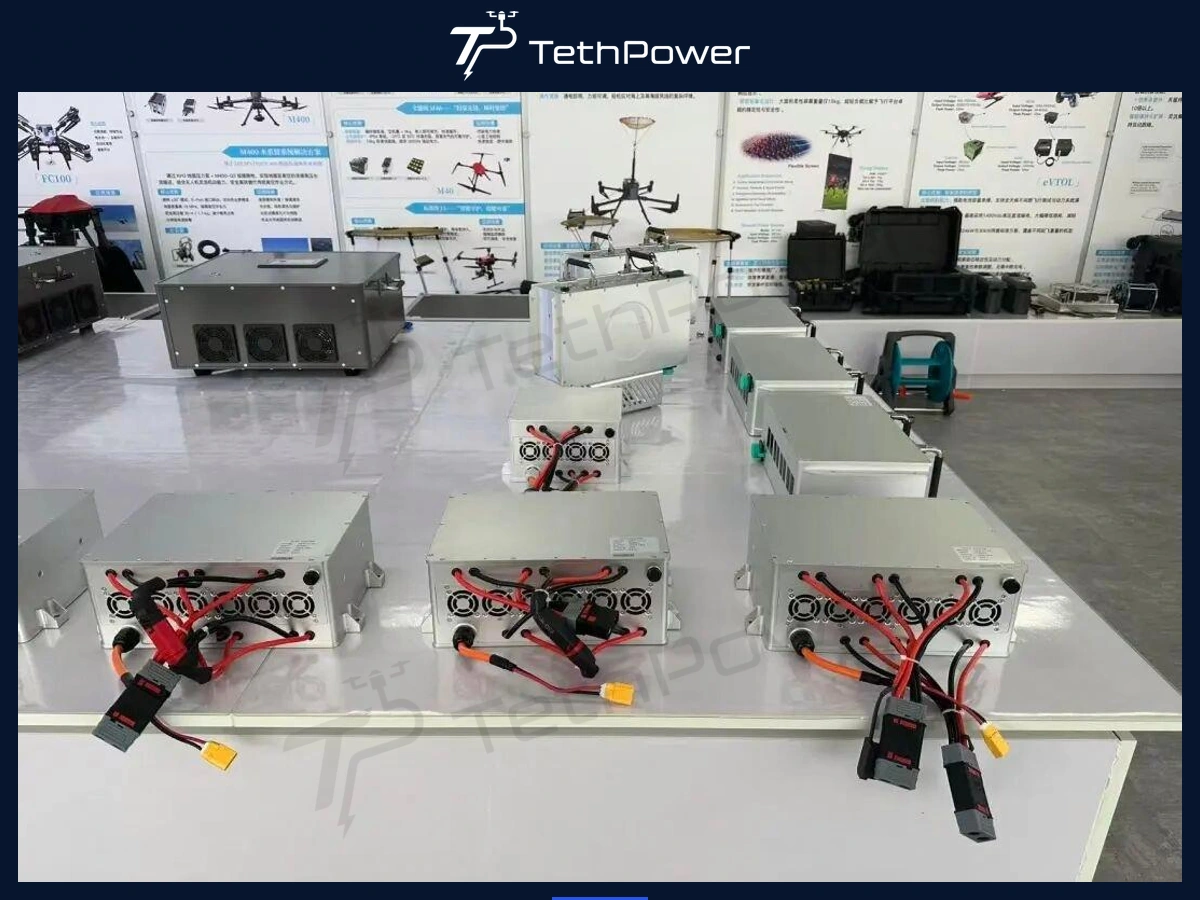
With a tethered system, a ground power station takes the AC supply on site, converts it to high-voltage DC and sends it up the tether cable. An airborne power module on the aircraft converts that supply to the voltage the aircraft uses. This can mean fewer landings and fewer battery-change interruptions, while the ground supply, the aircraft's thermal limits and its maintenance allow. It does not remove inspections, maintenance or the operating limits set by the aircraft maker.
Firefighting tethered systems are usually high power, and they are configured to the aircraft they supply. That is why we treat each firefighting project as a configuration built around your drone, not as a standard kit.
What we supply, and what you supply
We supply the tethered power chain:
- the ground power station, with its tether cable and winch;
- the airborne power module that mounts on your aircraft.
We do not supply the aircraft or a complete firefighting system; you supply the heavy-lift drone. Integration depends on your aircraft's take-off weight, battery voltage and motors, so our engineers review those details with you, and our sales team confirms the scope of supply for your project.
Our TP-FC100-FFB, a 100 L firefighting bucket for compatible carrier aircraft, is a separate carried accessory. It is not part of the tethered power chain.
The ground stations and airborne module we configure
High-power airborne modules such as TP-P70 are mostly used on firefighting drones. For firefighting projects, we usually start from one of the ground power stations below, or from higher power where the aircraft needs it, together with the TP-P70 airborne module. Each value is quoted with the label it carries on its product page.
Scroll horizontally to read the full table
Keep each label and condition with its value when you compare equipment; a kW figure alone does not select a system. Our guide to tethered drone power at 30 kW and above compares these products in more detail.
Why the ground station and airborne module are configured together
The standard TP-ST60 and TP-ST70 have a 1500 VDC default maximum system voltage, and their product pages ask you to confirm any other voltage with us before choosing an airborne module. TP-P70 lists a 1600–2000VDC input voltage range. We therefore do not present these products as a ready-made set.
For high-power modules such as TP-P70, we usually customize the ground power station to the project's requirements. We configure the ground station output, the tether cable and the airborne module together for your aircraft, and our engineers confirm the match before you order.
The aircraft side needs the same care. TP-P70 has a 116VDC rated output with a 110–118VDC range. Whether that output suits your aircraft depends on its battery voltage, power bus and motors, so firefighting configurations often involve customization. The airborne module's weight, mounting position and cooling path also use part of the aircraft's payload margin. Our ground station and airborne module matching guide explains each connection we check.
What to send us for your aircraft
To start the configuration, please send:
- the aircraft model, or a drawing for a custom airframe;
- the take-off weight and the payload you plan to carry;
- the battery voltage, the motors and the aircraft's sustained and peak power demand;
- the required tether length and operating height;
- the AC supply on site: 380 VAC three-phase supply, or a generator or mobile power station that will provide the ground station's AC input;
- the expected ambient temperature and site altitude.
Regulatory and flight approval rests with you as the operator, so check local rules before you plan the work. On site, follow the product manual and your site's own work rules.
Frequently Asked Questions
Do you supply a complete firefighting drone?
No. We supply the tethered power chain: the ground power station and the airborne power module, configured to your aircraft. We do not supply the aircraft or a complete firefighting system. Integration depends on your aircraft's take-off weight, battery voltage and motors, and our sales team confirms the scope of supply for your project.
Which ground power station and airborne module do you use for firefighting drones?
Firefighting tethered systems are usually high power: for example TP-ST60 or TP-ST70, or higher power where the aircraft needs it, with the TP-P70 airborne module. We configure the ground station and the airborne module together for your aircraft, and our engineers confirm the match.
Does tethered power remove the need for battery changes?
It can mean fewer landings and fewer battery-change interruptions, while the ground supply, aircraft thermal limits and maintenance allow. It does not remove inspections or maintenance. Follow the product manual and your site's own work rules, and check local rules for each flight.
Talk to our sales team
Talk to our sales team about price, lead time, samples, documents and the scope of supply for your firefighting project. Send your aircraft details through our contact page, or read how we approach custom tethered power projects. We provide remote technical support for the equipment we supply.
| Contact | Stella |
|---|---|
| Website | www.tethpower.com |
| stella@ | |
| WhatsApp / Tel | +86 177 1431 2943 |