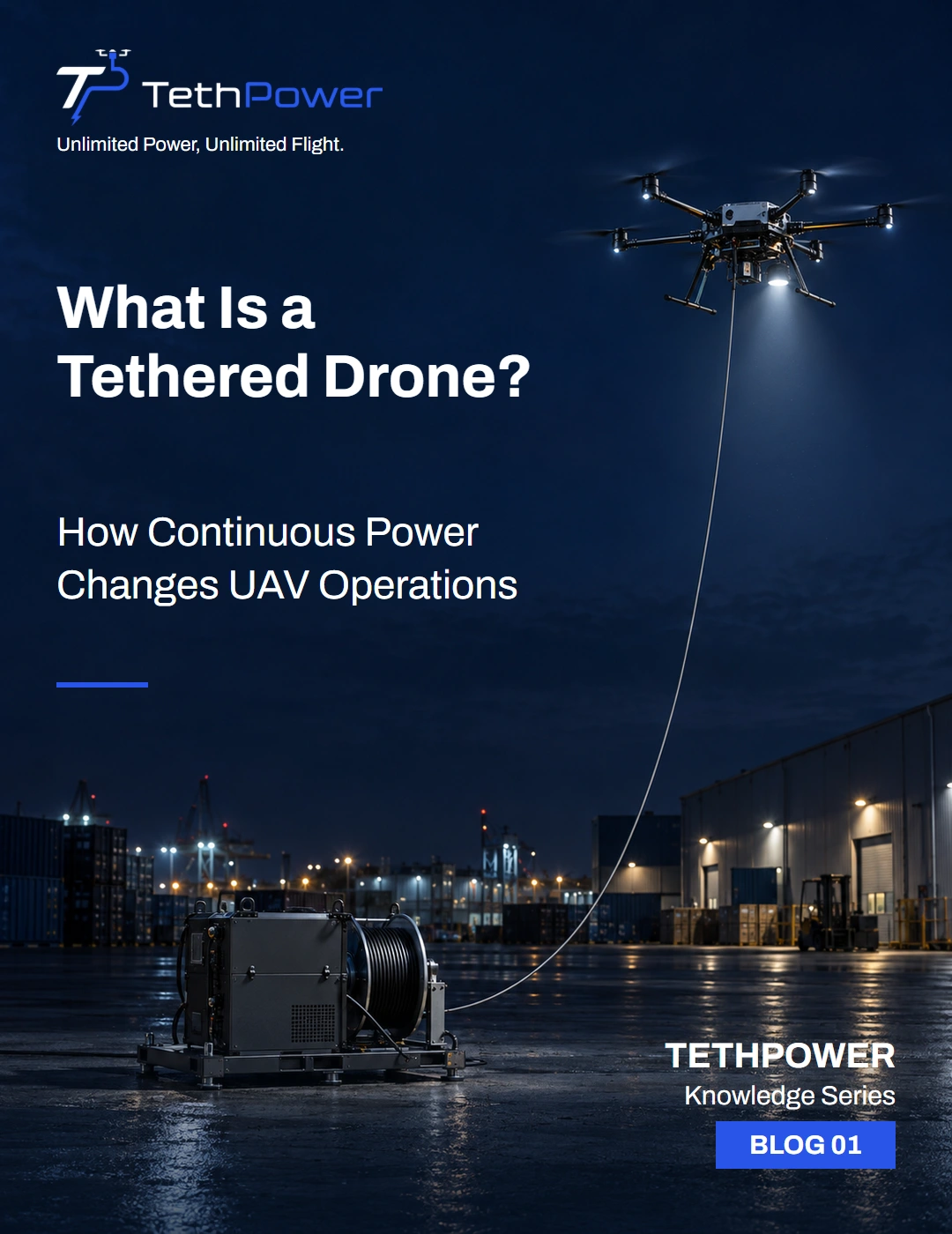
Answer in one sentence: A tethered drone is a UAV connected to a ground station by a lightweight tether that can continuously deliver electrical power - and, when required, fiber-optic data - so the aircraft can remain on station far longer than a battery-only platform.
Battery endurance is one of the most persistent limits in multirotor UAV operations. A capable industrial drone may carry excellent cameras, sensors, lights or mission equipment, yet the aircraft still has to land when its onboard battery reaches its operating limit. For mapping or mobile inspection, that is often acceptable. For a mission that needs an aircraft to stay over the same site for hours, repeated battery changes quickly become the operational bottleneck.
A tethered drone changes that equation. Instead of carrying all mission energy onboard, the aircraft receives power from equipment on the ground through a tether cable. The concept sounds simple, but a professional tethered UAV is really a complete power-transmission system combining ground conversion, high-voltage transmission, cable mechanics and airborne DC/DC regulation.
How a Tethered Drone Power System Works
1. Ground power conversion
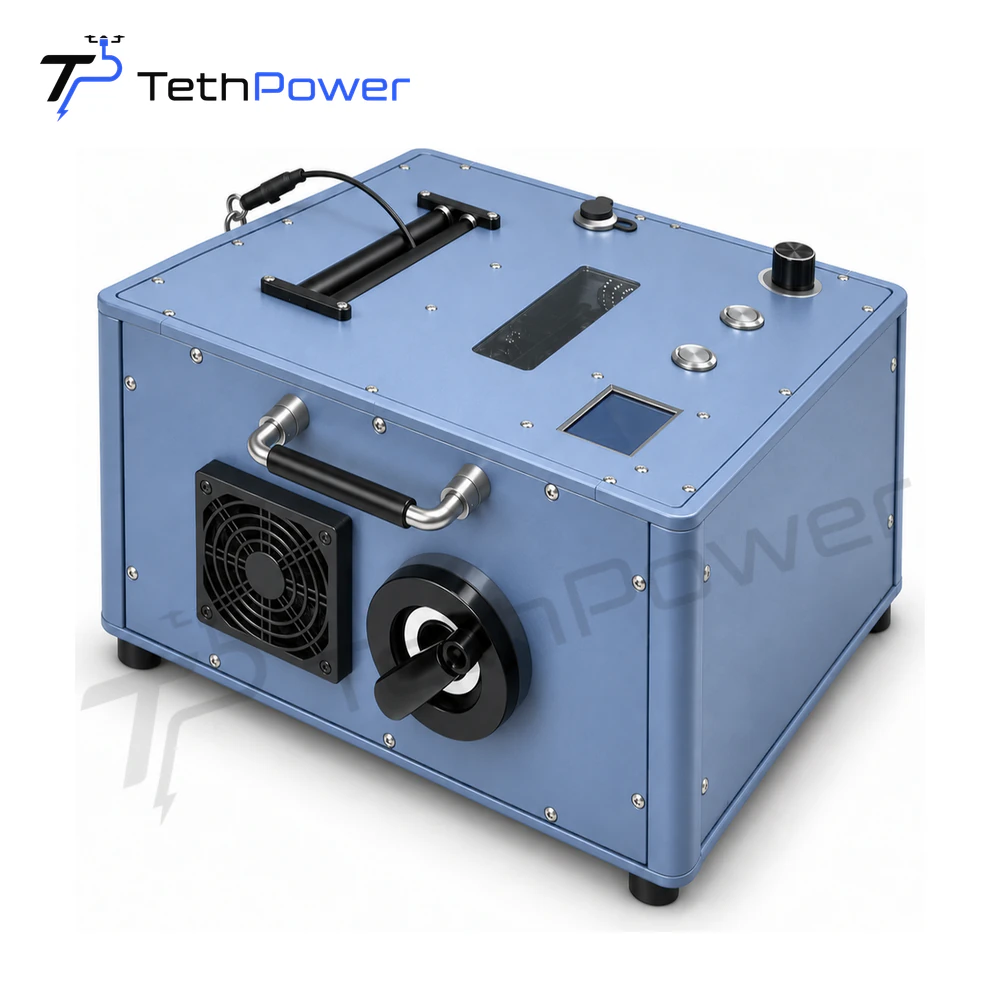
The ground power station accepts the available site power - commonly AC mains or a compatible generator source - and converts it into high-voltage DC. The purpose of increasing transmission voltage is not marketing; it is engineering. For the same power level, higher voltage reduces current, which helps control cable loss and cable conductor weight.
2. Lightweight tether transmission
The tether carries power from the ground to the aircraft while also acting as a physical connection between the two. Depending on the mission, the tether may contain power conductors only or combine electrical conductors with optical fiber. Tether design therefore involves electrical resistance, insulation, tensile strength, cable weight, bend behavior, wind loading and reel compatibility - not just cable length.
3. Airborne power conversion
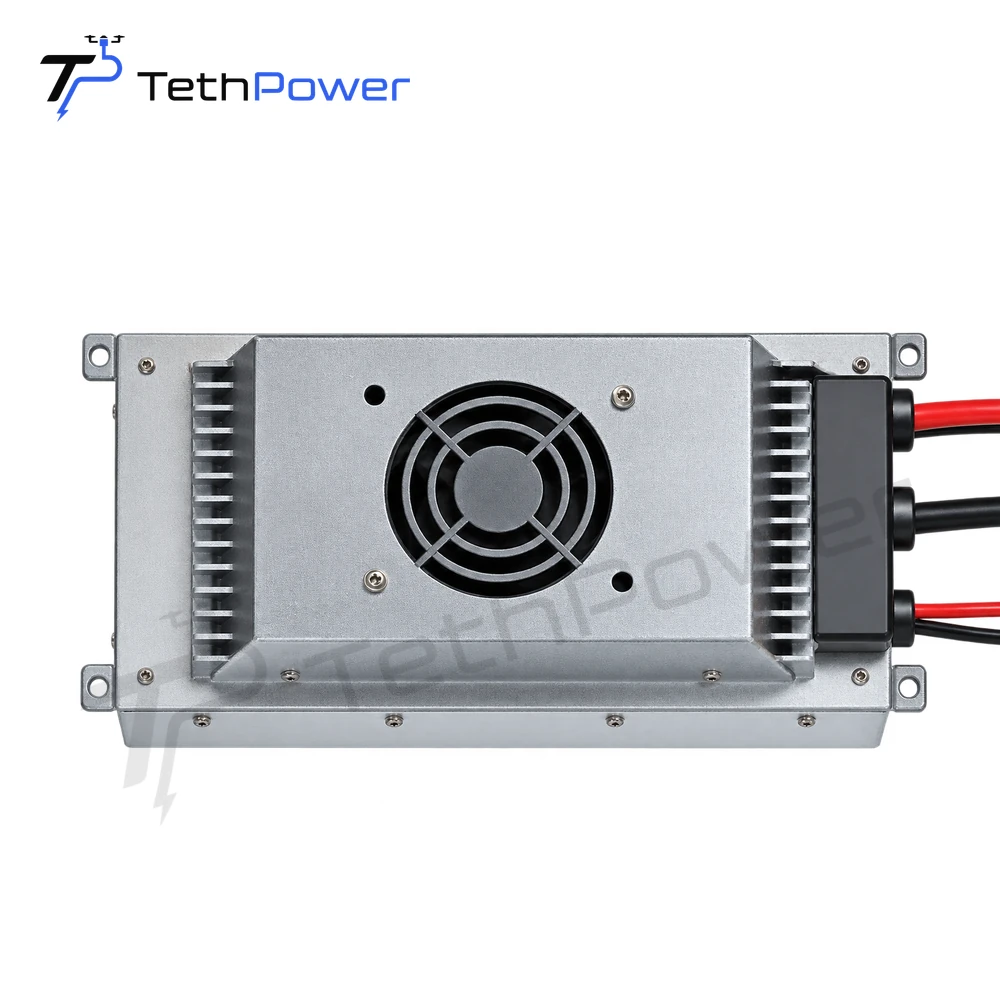
High-voltage DC arriving at the aircraft must be converted into the voltage required by the UAV power bus. The airborne module performs this DC/DC conversion and must be matched to the aircraft battery-equivalent voltage, continuous load, transient peak demand and cooling conditions. A 5 kW requirement at one bus voltage is not automatically interchangeable with a 5 kW requirement at another.
Configuration requirements: We start preliminary configuration with the aircraft voltage, real continuous power, peak power, MTOW, actual mission payload, operating height, site altitude and data-link requirement. This prevents a nominal kW number from being mistaken for a complete system specification.
What Is a Drone Tether?
A drone tether is the cable that joins a tethered drone to its ground power station, carrying electrical power to the aircraft and forming the physical connection between the two.
What a tether carries
For the same transmitted power, a higher voltage means lower current. That reduces resistive loss and allows a lighter cable, which matters because the aircraft has to lift the tether. A tether can also combine power conductors with optical fiber for wired data. Fiber is not standard on every unit: on TP-T36, data transmission is a customer-specific configuration.
How it connects the ground station and the airborne module
The ground power station converts site AC into high-voltage DC for the tether, and the airborne module converts that voltage to the level the aircraft needs. The tether joins the two, and its resistance, weight and connections also affect how they are matched. In our TP-Matrice M350 system for DJI Matrice 300/350, the ground unit supplies 400 VDC through a 110 m tether to an airborne module that accepts 380–410 VDC and supplies 48 VDC at 2,500 W.
What the tether limits
Working area. Tether length and site layout define a predictable working envelope, so tethered drones are generally intended for fixed-area or limited-radius operations.
Height. Cable length is not flight height. Routing from the reel, cable angle, sag, wind, ground clearance and safety margin all need extra cable. For TP-T36 and its 120 m cable, the recommended maximum flight height is 100 m, allowing for the angled cable path and a reserve of safety length.
Power. A longer cable adds resistance, heat and voltage drop, so usable power may have to be reduced or the system redesigned.
Rules. A tether does not remove local requirements. Site permission and aviation requirements remain jurisdiction-specific, and the local operator, customer or authorized local partner is normally responsible for approvals unless separately contracted.
For request details, see our guides on tether length and operating height and tether voltage and cable loss.
What Does Continuous Ground Power Actually Change?
The most visible benefit is endurance, but the more important operational change is continuity. A tethered UAV can stay in a defined area without the repeated landing, battery swap and relaunch cycle that interrupts battery-only missions.
Extended on-station time for surveillance, lighting, communications and other fixed-area missions.
Longer operation of electrically demanding payloads without relying only on onboard battery capacity.
Fewer battery-change interruptions and less mission downtime.
A predictable working envelope defined by tether length and site layout.
Optional fiber-optic communication when a mission needs wired data transmission or reduced RF dependence.
Where Tethered Drones Make the Most Sense
Persistent surveillance
EO/IR cameras and other sensors often benefit more from persistent altitude than from long horizontal range. A tethered platform can maintain an elevated observation point while receiving continuous power from the ground.
Emergency and temporary aerial lighting
Lifting a light source above vehicles, walls, vegetation and other ground obstacles can produce a useful overhead lighting angle for temporary sites. Portable tethered lighting systems are especially attractive when crews need fast deployment without erecting a conventional lighting mast.
Facade and industrial cleaning
Cleaning missions can combine a power tether with a separate water hose. Continuous electrical power supports the aircraft while ground pumps provide the cleaning medium, allowing longer work cycles than battery-only operation.
Communications relay and RF-sensitive missions
A tethered UAV can hold antennas, repeaters or communications payloads at altitude. Where stable wired data is required, a power-and-fiber composite tether can carry optical data alongside electrical power.
UAV and lightweight eVTOL testing
Development teams may use tethered power for controlled hover, endurance, propulsion and flight-control testing. The objective is not unrestricted flight; it is repeatable testing in a defined envelope with a stable power source.
Tethered Drone vs Free-Flight Drone
Tethered and battery-powered drones solve different problems, so the mission decides which one fits.
Scroll horizontally to read the full table
For the full comparison, including payload and deployment, read Tethered Drone vs Battery-Powered Drone.
When a Tethered Drone Is Not the Right Tool
Tethered systems are not a replacement for every battery-powered UAV. They are strongest when persistence matters more than mobility. A conventional battery drone is usually better for wide-area mapping, long-distance inspection, patrol routes and missions that require continuous horizontal movement over large distances.
There is another important boundary: continuous ground power does not mean the aircraft itself can operate forever. Motors, bearings, cooling systems, electronics, weather exposure and maintenance intervals still matter. Professional tethered operation requires the same discipline as any other industrial UAV mission.
How we approach tethered UAV design
We develop tethered power solutions around the aircraft and mission rather than forcing every UAV into one standard box. The required architecture changes with aircraft voltage, power level, tether length, available payload, ground power, environmental conditions and communication needs.
That engineering approach supports a broad range of applications, including lighting, surveillance, cleaning, industrial testing, DJI platform integration and higher-power emergency or heavy-lift missions. The common principle is simple: the power chain has to be matched end to end.
FAQ
Can a tethered drone fly indefinitely?
Ground power can remove the normal battery-cycle limit, but actual operating duration still depends on the aircraft, motors, thermal conditions, weather, maintenance and site procedures.
Can a tether carry both power and data?
Yes. A composite tether can integrate optical fiber with power conductors when the mission requires wired data transmission.
How high can a tethered drone fly?
There is no universal height. Practical height depends on cable weight, electrical loss, aircraft payload margin, wind, power demand and the selected system architecture.
What information is needed to select a system?
Start with aircraft battery voltage, continuous and peak power, MTOW and mission payload, required height, operating altitude or temperature, ground power and whether fiber is required.
Talk to us
For a faster preliminary recommendation, send your aircraft model, battery voltage, continuous and peak power, required operating height or tether length, and destination country.
| Contact | Stella |
|---|---|
| Website | www.tethpower.com |
| stella@ | |
| WhatsApp / Tel | +86 177 1431 2943 |
TethPower | Tethered UAV Power Systems and Mission Equipment